Contact Pest Control Excellence
Service area: George and the wider Garden Route

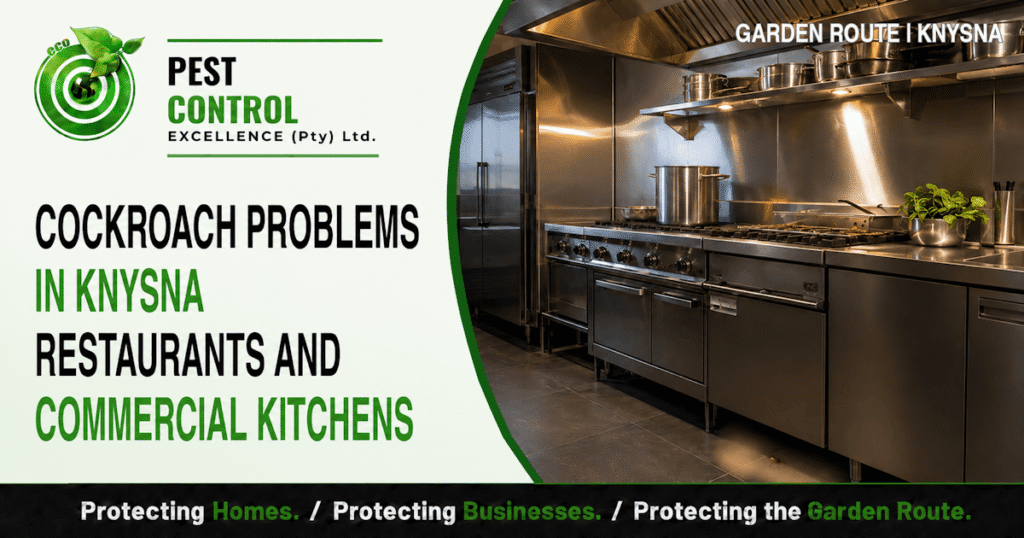
Knysna is one of the Garden Route’s most popular tourism and dining destinations. Its restaurants, cafes, guesthouses, takeaways and commercial kitchens serve residents and visitors throughout the year, with particularly busy periods during holidays and local events.
These food businesses depend on cleanliness, customer confidence and consistent hygiene standards. Unfortunately, commercial kitchens can also provide cockroaches with everything they require: food, water, warmth and protected hiding places.
One cockroach sighting in a restaurant can create concern among customers and staff. More importantly, the visible insect may be only a small indication of activity hidden behind appliances, beneath counters or inside service ducts.
Understanding the causes and warning signs of cockroach problems can help Knysna food businesses respond quickly and protect their premises, food-handling environment and reputation.
Restaurants and commercial kitchens produce heat, moisture and food residue every day. Even a well-managed kitchen can develop vulnerable areas that are difficult to reach during ordinary cleaning.
Cockroaches may be attracted by:
Commercial kitchens may remain warm after closing, allowing cockroaches to become active when staff have left and the premises are quiet.
A pest problem does not always mean that the visible surfaces are dirty. Activity can develop inside concealed areas that require targeted inspection.
Cockroaches generally remain hidden during the day and become more active at night. Their flat bodies allow them to enter very narrow spaces.
Common harbourage areas in commercial kitchens include:
Warm appliance motors are particularly important inspection points. Grease, food particles and moisture may accumulate around equipment that is seldom moved.
Repeated sightings in the same area usually justify a closer investigation of the surrounding voids, fittings and service routes.
Early detection can prevent a minor cockroach problem from becoming established.
Kitchen, cleaning and management teams should be trained to report:
Daytime sightings may indicate that hiding areas have become crowded or that an established population has been disturbed.
Staff should record where and when activity was observed. Simply removing the visible insect without reporting it can delay the identification of the source.
Cockroaches and egg cases may enter a food premises inside cardboard boxes, crates, packaging, second-hand appliances or other delivered goods.
Deliveries should preferably be inspected before products are moved into the kitchen or storeroom. Staff should check box folds and corners, damaged or stained packaging, egg cases or droppings, insects beneath pallets, used beverage crates and second-hand kitchen equipment.
Unnecessary cardboard should be removed from food-handling and storage areas promptly. Dry ingredients should be transferred into suitable sealed containers where appropriate.
Stock rotation is also essential. Older products should not remain forgotten behind newer deliveries.
Daily cleaning is essential, but visible worktops and floors are only part of the kitchen environment.
A more thorough cleaning programme should include:
Food and grease should not be allowed to accumulate in inaccessible spaces.
Cleaning schedules should clearly identify who is responsible for each area and how often it must be inspected. Managers should verify that difficult areas are actually being reached instead of relying only on completed checklists.
Cockroaches need access to water. A small, dependable moisture source can support activity even when food is carefully controlled.
Commercial kitchens should regularly inspect taps and pipe connections, dishwasher hoses, ice machines, refrigeration condensation trays, floor drains, geysers, sinks and water collecting beneath appliances.
Leaks should be repaired promptly. Floors should drain correctly, and standing water should not remain after cleaning.
Persistent cockroach activity near a drain does not automatically prove that the insects originated inside it. Gaps surrounding drainage pipes, damaged covers and nearby structural openings should also be investigated.
Food waste can attract cockroaches both inside and outside the building.
Indoor refuse bins should have secure lids and be emptied regularly. The bins themselves must be cleaned, as residue can remain on their bases, wheels and surrounding floors.
Exterior refuse areas should be kept clean, have properly closing containers, remain free of spilled food, provide adequate drainage and avoid excessive cardboard accumulation. Containers should be positioned away from entrances where practical.
Vegetation, leaf litter, damp mulch and stored items close to the building may support outdoor cockroach activity. Doors, pipe openings and other possible entry points should therefore be inspected and suitably sealed.
Spraying a visible cockroach may kill that individual without reaching the hidden infestation.
Incorrect or excessive spraying can scatter cockroaches into deeper structural spaces. It may also contaminate food-contact environments or interfere with professionally placed bait.
Effective cockroach management normally combines:
Any treatment inside a food premises must be selected and applied with careful consideration for food, preparation surfaces, equipment, staff and customers.
Restaurants and other food-handling businesses must maintain appropriate hygiene and pest-prevention standards.
South Africa’s Regulation R638, governing general hygiene requirements for food premises and the transport of food, requires effective measures to prevent pest access, breeding and contamination.
Pest management should therefore be treated as part of the business’s broader food-safety programme – not only as an emergency response after cockroaches are seen.
Useful pest-management records may include inspection dates, areas inspected, activity observed, monitoring results, treatments performed, corrective actions, repairs, cleaning and follow-up findings.
Accurate records help management identify recurring problem areas and demonstrate that pest risks are being actively managed.
A cockroach sighting can damage a restaurant’s reputation very quickly. Customers may share photos, post online reviews or report concerns before management has had an opportunity to investigate.
Prevention and early detection are therefore far better than reacting to a public incident.
Managers should establish a clear procedure for staff to report pest activity immediately and discreetly. The affected area should be assessed, potentially exposed food should be managed safely, and professional assistance should be obtained when necessary.
The priority should always be to identify and correct the underlying source.
Pest Control Excellence has provided professional pest-management services since 2007.
We assist restaurants, cafes, accommodation establishments, food-service businesses and commercial kitchens throughout Knysna and the surrounding Garden Route.
Our approach includes inspecting likely harbourage areas, identifying conditions supporting cockroach activity and developing an appropriate treatment and monitoring programme for the premises.
Practical recommendations may also be provided regarding sanitation, moisture, storage, exclusion and staff reporting procedures.
For more information about our complete range of local services, visit the Pest Control in Knysna Service Area page.
Cockroach control in a restaurant or commercial kitchen requires more than removing the insects that staff can see.
Successful long-term management depends on early reporting, detailed inspection, disciplined cleaning, moisture control, safe food storage and targeted professional treatment.
A proactive pest-management programme helps protect the food-handling environment, the business’s reputation and the confidence of every customer who walks through the door.
Service area: George and the wider Garden Route